Pathology
Its own export
Connect clinical data. Accelerate trials.
Trialayer links the spreadsheets a site already exports from services that do not talk to each other, pseudonymizes them in the browser, and counts how many patients fit a protocol — so a feasibility question that used to be answered from memory is answered with an auditable number.
- Local pseudonymization
- No EHR integration
- Patient records never leave the browser
The problem
Sites lose studies over a number nobody counted.
A sponsor asks how many patients you see with a condition. You have days to answer, no time to count, and no system that keeps the tally — so the answer comes from memory. Sometimes it undersells a site that had the population. Sometimes it wins a study the site cannot fill.
Both are expensive, and the second is worse: the site that promises and does not enroll is the one that stops getting asked.
1 in 3
activated sites never enroll a single patient
20–50%
of trials need a rescue mission
US$600k
to 8 million is the cost of each day of delay
Industry reference figures, not Trialayer results. We do not have customers yet, and we would rather say so.
Who it's for
Two sides of the same table
Sites and sponsors negotiate over a number nobody measures today. Trialayer measures it once, inside the site, and both sides look at the same figure.
Research sites
Hospitals, clinics, dedicated sites and academic teams.
- Answer with evidence, not from memory.
- From the spreadsheets you already export. No EHR project.
- You see the number first, and decide whether to send it.
Sponsors and CROs
Feasibility and site selection teams.
- Measured figures, not numbers declared on a form.
- With the methodology in the header, and the undetermined rate shown.
- Find the sites that already see your population, before you activate one.
How it works
Four steps, and the order between them matters
It runs in your browser. There is nothing to install and no EHR integration: the spreadsheet is read from your own disk, and no request leaves the tab while it works.
Drop in what you already export
Excel or CSV from pathology, pharmacy, discharges. Exactly as they come out of the system, with no renaming of columns and no format conversion. The file is read from your disk — it is not uploaded anywhere.
Tell it which column is which
The system proposes and you confirm. It never applies a guess on its own: if the identifier is wrong, different patients get linked together, and that does not show up when you look at the result.
Records are linked, then pseudonymized
Linking happens inside the site, using the identifier, because linking requires one. It is discarded immediately after: everything downstream works on subject codes, derived with a key your site generates and keeps.
This is pseudonymization, not anonymization. Because your site holds the key, the data remains personal data under Law 21.719 — which is what makes deduplication possible in the first place. Our duties as a processor, the DPA and the impact assessment all stand.
A number comes out, and nothing else
With its period declared, its methodology in the header and the cell threshold already applied. And only when you press send.

Your exportsxlsx · csv
Linkedinside your site
Pseudonymizedfail-closed
One countnothing else
What shows up when you count
The patient who was never tested
When a criterion cannot be evaluated because nobody ordered the test, that patient is not ruled out: they are unknown. The difference decides whether the site orders the test or does nothing.
That number exists nowhere today. Trialayer separates it from genuine exclusions instead of mixing the two, because mixing them deflates the figure and loses studies the site could have won.
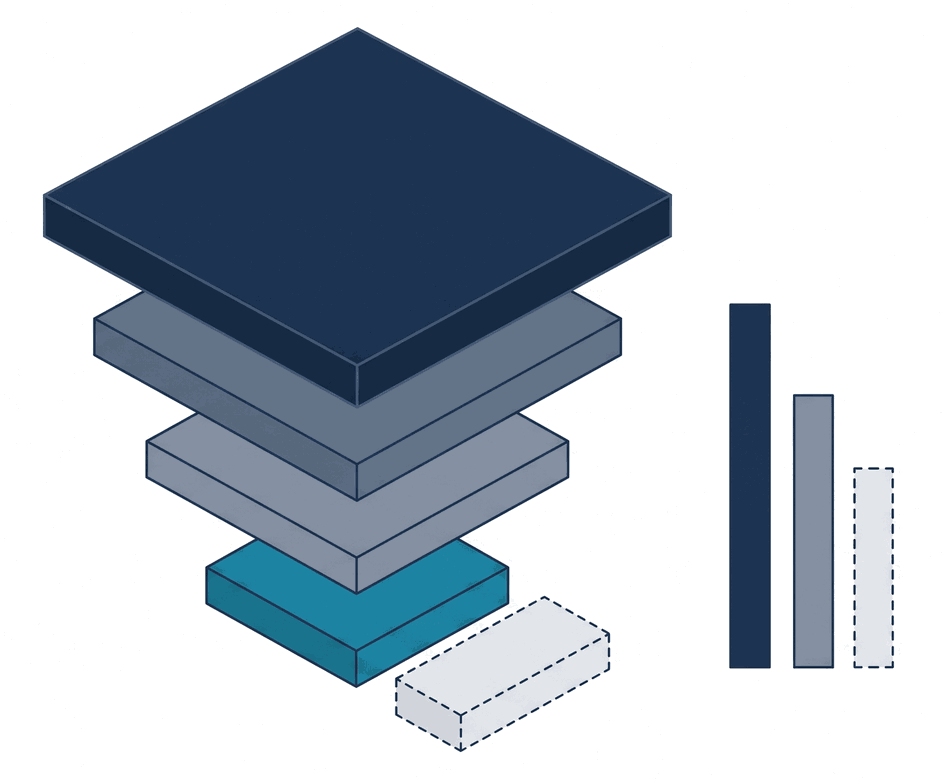
- Screenedeveryone the site evaluated
- Ruled outa clinical reason
- Eligiblefit the protocol
- Undeterminednobody ordered the test
What is guaranteed
Your data team's questions, answered up front
These are not brochure promises. Each one is built as a rule of the system, and there are automated tests that fail if any of them breaks.
Where the data goes
No EHR integration
We work on what the site already exports. It does not connect to
your system and needs no IT project.
Spreadsheets stay in the browser
Read from your disk, linked and pseudonymized in the tab. An
aggregate number goes out, and only when you send it. Image documents
are redacted by your team first and then read by our service, never by
a third party.
Fail-closed pseudonymization
If it cannot guarantee a record came out free of identifiers, it
blocks it. It does not continue with a warning.
Cell threshold
No small-count category is ever released on its own. Applied at
count time, not at display time.
Who can do what
An account per person, not per site
Whoever uploads the spreadsheet is not whoever answers the sponsor.
Roles are checked on every request, not drawn on a screen.
Sending is a separate permission
Only the principal investigator and study coordination can release a
number. Recruitment staff and monitors cannot.
Two-factor sign-in
A six-digit code from a phone, on top of the password. Sessions die
after 20 idle minutes — nursing stations are shared.
What survives an audit
Nothing is deleted
Append-only from day one. A correction inserts a new version and
keeps the previous one, with who and when.
Every access attempt is logged
Who signed in, when, and every failure. Never the password that was
typed.
Chile Law 21.719
Designed against the Chilean sensitive-data regime, in full force on
1 December 2026. The DPA clauses and the DPIA scope are drafted; neither
is signed, and no real record is touched until they are.
What it does not do
Saying this is part of the product
It does not diagnose or recommend treatment. It counts, and shows the basis for every claim with a citation to the document and the date of the data.
It does not claim population prevalence. The system has no way to say "this site has N patients". It can only say "of the N screened in this period, M qualify", because that is what the data supports.
It never pays or rewards per referred patient, in either direction. It is prohibited by Article 46 of the Chilean Medical Association code of ethics, and no function exists that would allow it.
It does not read charts to hunt for candidates. That requires an ethics committee waiver and is out of scope for the product.
FAQ
What comes up in the first meeting
Do I have to integrate my EHR?
No, and it is not on the roadmap. Trialayer works on spreadsheets your site already exports — pathology, pharmacy, discharges — in Excel or CSV, exactly as they come out of the system.
No renaming of columns and no format conversion: when you drop the file in, you declare which column is which. It never leaves the browser.
Where does my patient data live?
Spreadsheets never leave the browser. They are read from your own disk, linked, pseudonymized and counted in the tab. You do not have to take our word for it: press F12, open the Network tab, and drop your file — the request list does not move.
Clinical documents in image form are different, and we would rather be exact about it. A member of your team blacks out the direct identifiers on the image itself, in the browser; those pixels are destroyed before the file exists. Only that redacted image is sent to our text-recognition service, which runs on our own infrastructure — not a third-party AI provider — currently hosted in São Paulo, Brazil. That is an international transfer, it is covered by the safeguards Law 21.719 provides for, and it is written into the data processing agreement.
That service writes nothing to disk. It does not keep the image or the text once it has read them, and it returns only short clinical variables with the literal quotation that backs each one — never the full text.
Do I need ethics committee approval to use it?
The architecture does not exempt you from it, and we will not tell you otherwise. What an ethics committee authorises is access to the clinical record for research purposes — not the place where the processing runs or the technique used to run it. Those are two different questions and only one of them is ours to answer.
Counting your population from administrative exports the site already has the right to cross-reference is the provider's own administrative processing, and in our reading it does not require a waiver. Reading a patient's clinical document is a different matter: whether it needs one depends on the setting — treating team with the patient present, or retrospective screening without them — and that is the committee's call, not ours.
What we do give you is a straight account of the data flow to take to the committee, including the parts that count against us. We would rather you arrive with that than with a claim that does not survive the first question.
Is it a medical device? Does it need regulatory clearance?
It does not diagnose or recommend treatment. It counts, and shows the basis for every claim with a citation to the document and the date of the data, so the clinical decision stays with the clinician.
This is a position with no precedent in Chile yet, and we say so rather than claiming otherwise.
How long does it take to get running?
There is nothing to install, so there is no IT, security or procurement queue to wait in — which was the expensive part. What takes time is the first conversation about which data sources exist and what columns they carry, and that is one meeting.
What does it cost?
There is no price list yet, and we would rather say so. What is decided: nothing is ever paid or charged per referred patient, in either direction, per Article 46 of the Chilean Medical Association code of ethics.
In other markets site software is passed through in the study budget. We are checking whether that applies in Chile.
What if the count makes my site look bad to the sponsor?
You see the number first, and it does not leave until you press send. Without that rule the product would be an informant and no site would use it.
Besides, a low number you can back up protects you more than a high optimistic one: the site that promises and does not enroll is the one that drops in the scorecard.
Talk to us
Tell us what your site exports. We will tell you if this fits.
What we ask for is the column headers of one spreadsheet you already export — not your data, just the headers. With that we can tell you what the count would look like at your site.
Twenty minutes, and it commits you to nothing. The demo runs on a synthetic corpus: no real patient data, not even de-identified.